Does your house have any water damage?
Check for these warning signs right away so you can identify and stop the problem before it gets worse.
•Standing water on the floor. The most obvious sign of impending water damage are pools of water on the floor, most usually in the kitchen. These pools of water indicate that there's a continuous leak somewhere and it has been escaping the normal process of evaporation. If you've already mopped up standing water on your floor and then find some again the next couple of days, then put the mop aside and start looking for leaks or drips. You can mop all you want but as long as you don't fix the source, you will always end up doing the same thing. Your floor will also get damaged day after day.
•Indicators in the house's structure. If your floor begins to buckle slightly, then water is probably present. The reason for this is that vinyl floors are laid over particleboard underlayment that absorbs water and then swells up. If you have hardwood floors, water cups up around the tongue-and-groove joints.
The most common area where water damage is seen is the bathroom in front of the tub or shower --- the damage can occur from splashing or where people step in and out with dripping feet. Keep an eye out for any buckling.
For drywall, check for a discolored or slightly swollen appearance since drywall softens and breaks down.
•Appearance of stains. Next to standing water, the appearance of stains in several parts of your house is a good indication that you have a leak or water encroachment somewhere. The stains may appear:
•Around the windows or on the bottom of the exterior doors, indicating that the water is coming from the outside;
•At the joint between the exterior wall and the ceiling --- it can also mean an ice-damming problem;
•Anywhere in the ceiling, which is almost an indication of a roof leak, unless you have installed water lines in your attic. If you see stains on your ceiling, remember that it does not mean the leak is right above it. Usually, it originates higher and just drips down.
•In cabinets that house a sink --- an indication of a leak in the sink drain system or from the trap.
•Where there are mildew and mold stains. While not exactly definitive proof of a leak, the presence of mildew or molds indicates moisture. In a bathroom where moisture is prevalent, it's an indication that you just don't have enough ventilation to rid the room of mildew. If you see them at the bottom of an exterior wall, it might mean that water is coming in. In closets or places where there is little or no air circulation present, it could mean an overly damp crawl space.
Showing posts with label ice buildup on a roof. Show all posts
Showing posts with label ice buildup on a roof. Show all posts
Tuesday, March 16, 2010


Wednesday, February 17, 2010
Part TWO - Removing Ice from Sloped Roofs
When is there a problem?
The lower the slope, the greater the weight problem. During the ‘98 ice storm many flat roofs had 15 cm (6 in.) of solid ice, while most sloped roofs had little more than 5 cm (2 in.). Most of the ice collected at roof junctions, behind obstructions such as chimneys or skylights, and at roof edges. Drainage, not removal, solved the problem in most cases.
The information in Signs of Stress will help you decide if weight is causing problems on your roof. If your house doesn’t show signs of stress, then there is no need to remove all the ice.
Drainage
On a sloped roof, your goal is to make drainage paths through the ice on the lower edge of the roof. That’s where most ice dam and water back-up problems occur. Always shovel off loose snow to expose the ice.
If you have power and electric heating cables, making drainage paths is fairly easy. Attach loops of electrical roof de-icing cables to one or more long boards. With ropes tied to the board and thrown over the roof, pull the board up beyond the ice dam, letting the electrical loops hang slightly off the edge of the roof.
If you want drainage paths higher on the roof, use bundled loops of electrical de-icing cables. They can be drawn high on the roof. Make sure that they hang off the edge of the roof so you get complete water drainage.
You can use chemical de-icers on the edge of the roof. Clear the snow. At about every three feet along the edge of the roof, break the ice crust just above the ice block on the edge of the roof. Put de-icer in each hole above the ice dam and in a vertical line down to the edge of the roof. Use noncorrosive de-icers (see De-icers) and use as little de-icer as possible. Repeat as necessary rather than overdoing it the first time.
Removal
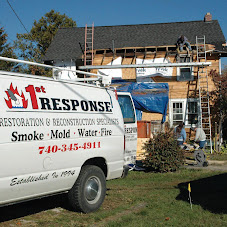
Removing ice mechanically from a sloped roof is always dangerous — both for the person doing it and for the roof. Removing ice will probably invalidate your shingle warranty. If ice must be removed, have it done by 1st Response, 740-345-4911. They have the proper equipment and training.
Researchers learned a great deal about removing ice from sloped roofs by mechanical means in the winter of 1998. The most important lesson: always start at the top and work down. Starting on the bottom can release ice above you that can slide down and hit you. Small bumps of ice that remain on shingles are caught by ice blocks sliding down. As they slide, they catch and rip off the shingles.
Working from the top down allows you to use the ice on the roof as a slide for the ice that is being freed. Use a sledge hammer rather than an ax.The flexibility of the roof deck will cause the ice to fracture and you will not cut into the shingles.
Freezing Rain
Freezing rain is caused when there is a particular atmospheric “sandwich” of cold and warm air. Precipitation, usually snow, is formed in cold air high up in the atmosphere. As it falls, it travels through a layer of warm air that thaws it into light rain. Just before it hits ground level, it moves into another layer of cold air that brings its temperature to below freezing, but it doesn’t have time or the conditions necessary to crystallize yet. When it hits an object, it immediately freezes.
Snow will collect and then fall off wires and tree branches, and remain relatively light as it accumulates on roofs. Freezing rain compacts into tenacious ice that can weigh almost as much as water. The ice storm of 1998 was in fact a continuous series of small storms, one right after the other, that deposited up to 15 cm (6 in.) of ice on tree twigs, telephone wires, electrical lines and roofs. There is no way to stop freezing rain and it is not generally considered a hazard unless it becomes unusually thick.
The 1998 ice storm created two problems: direct weight and blockage of the natural flow of rain and melting ice. The freezing rain stuck all over the roof, not just on the bottom edge, and created ice dams. The dams backed up run-off water just about anywhere on the roof. Flat roofs suffered serious weight problems, while sloped roofs tended to suffer more water-penetration damage.
1st Response
Subscribe to:
Posts (Atom)