Showing posts with label Knox. Show all posts

Saturday, June 28, 2014

It can happen ..... and did

I realize that this has nothing do with our business, but, there is a message here, for ALL to hear.

I am so saddened by this senseless, needless accident here in our own county. Five young lives, three ended, and two who will never forget the incident, there lives, in a way, were also taken. Five lives, looking forward to a Summer and all the Summer activities ..... probably excessive speed, on a long straight stretch on a county road, the cause. If you have children, show them this photograph, show them that it can happen, and tell them the consequences.

Johnstown is a lovely little central Ohio community, a very close-knit community, one with porches, still lining streets. I have passed through that town, in the evening, and noticed people walking down the sidewalks, sitting on their porches, waving and greeting. It is that kind of a community, and I am sure the entire community is saddened by this tragic accident. Let your kids and your family know that if CAN happen, to anyone, in a split-second ......

LICKING COUNTY, Ohio - Ohio State Highway Patrol says three people are dead and two people are injured after a single car accident in Licking County. According to police, a silver Mitsubishi Diamante carrying five people smashed into a tree and split in two just after 1 PM on Hardscrabble Road, near Alexandria. All three passengers in the back seat of the vehicle - two females and one male - were partially ejected during the crash and killed. 
They were not wearing seatbelts. 

Police say the victims were, 17-year-old Michael Hoskinson, 15-year-old Chyenne Spurgeon and 15-year-old Linzie Bell. Two occupants in the driver's and passenger seat were injured in the crash, but survived. Their condition is unknown. All of the car's occupants were between 15 and 17-years-old.

Investigators say skid marks just before the impact may indicate either the driver applied the brakes or he was traveling so fast he was trying to regain control of the car before it struck the tree. 

Police say speed was a factor in the crash.

Sunday, February 23, 2014

That time of year ....

We are nearing that time of year, the Gutter Cleaning Season. Baseball's Spring Training is underway, and means that Spring is not too far behind. 

Gain access to the roof with a ladder. Don't lean the ladder against a downspout or gutter, which can easily bend or break. Remove leaves and twigs from gutters by hand or with a large spoon, a gutter scoop or a small garden trowel.

Wet down caked-on dirt, which can be difficult to remove without damaging the gutter itself, then remove it with the gutter scoop or trowel. Put debris in a bucket or plastic trash bag placed on the roof or ladder. If you use a bag, you can just drop it when it's full.

Check that the downspouts aren't clogged. Use water to unclog your downspouts by placing a garden hose in the opening. But be gentle at first; downspouts aren't designed to withstand the same pressure as a house drain. If a plugged downspout can't be cleared with a hose, use a small plumber's snake or an unbent clothes hanger. Again, be gentle. Gutters are not as strong as house pipes.

Alternatively, use a leaf blower to clean the gutters; however, remember that you'll be high up, often in awkward postures, and carrying a good-sized machine that not only is awkward to use but also can blind you with dust.

Use the hose to flush the gutters with water after cleaning. (This is also the best time to find out if there are any leaks in the system.)

Thursday, April 4, 2013

Biohazard Decontamination Unit


Our Newly expanded services, Biohazard Decontamination Unit, is under way! 

While we pray none of you are ever exposed to this situation, these services can be provided with compassion and detail by the staff at 1st Response. 

If you need crime scene clean-up guidance, have questions about your payment options, which crime scene clean up procedures your current insurance policy covers or require our cleanup services immediately, don't hesitate to call 1st Response at: 888-233-4321.

· Your regular cleaning or janitorial service has not been properly certified OR equipped to handle biohazardous waste such as blood or bodily fluids, and does not have a legally accepted mechanism in place to dispose of the recovered bio-hazard waste.

· Federal Regulation 29-CFR-1910.1030 states that no employee can be placed in a position to be exposed to a blood spill without first:

1. Bloodborne pathogen (BBP) training.

2. A written BBP exposure control plan.

3. Proper training on the correct usage of personal protective Equipment.

4. Hepatits B vaccine, exposure evaluation follow-up.

5. Proper method to store and dispose of biohazardous waste.

Body protection is required for employees who face potential bodily injury of any kind that cannot be eliminated through engineering, work practice or administrative controls while performing their jobs. 

Exposure to blood and other body fluids is an example of a workplace hazard that could cause bodily injury. In addition, exposure may cause illness. - OSHA (Occupational Safety and Health Administration) 


or 
740-345-4911
 or info@ohio1st-response.com.

· LICKING COUNTY
· KNOX COUNTY
· COSHOCTON COUNTY
· MUSKINGUM COUNTY
· PERRY COUNTY
· FAIRFIELD COUNTY


Monday, October 22, 2012

Last February we moved our offices to our current location in East Newark , and during the move I found a baseball that was nestled in the back of a large drawer. I glanced down, and there was that famous signature, I remember when I asked him to sign it, he graciously did, and it brought back so many memories.

The year was 1981, a hot sultry August Saturday night under a full moon with over 12,000 cheering fans crowded in to Don Edwards Babe Ruth Baseball facility. Baseball  players 19 years old  from all over the
United Sates that were selected by a sophisticated tryout program orchestrated by the (United States Baseball Federated) and  (IMBIA) a division of the Olympic Committee were standing at attention as the National Anthem played.

As the National Anthem faded into the night the fans went wild as they cheered for boys that they had grown to know during the last seven days. They came from all over the world to play in the world’s first World Friendship Baseball Series.

Across the field stood the opposing team standing in a regimented format looking almost military like. The Korean music began to play and the entire ball park stood at attention as we listened to the words and music to their National Anthem. The Anthem came to an end and again the standing room only baseball facility went berserk as the United Stated cheered and welcomed the team from Korea .

The evening was the highlight of one of the largest "all volunteer" events ever organized in Newark , Ohio .

Let’s go back in time…..

It’s the summer of 1979 several months after our Second Babe Ruth World Series, we were campaigning and using every contact from the Governor to local business leaders for their support in hosting the first ever World Friendship Baseball Series to be comprised of 11 teams from almost every continent in the world and a team from the United States.

Our community organized many people and businesses during the two Babe Ruth World Series,so we were the first choice by the United States Baseball Federation” and “IMABA,” a branch of the world Olympic Committee, to host the first ever World Series for 19 year olds. .
  
During lunch at Annarino’s Center Cafe, Don Edwards, Roger Balding and Tom Newman approached me to be the “Host Chairman” of the first ever International World Baseball Series ever held for 19 year olds. This series was to be the format for selecting teams and players to play baseball in future Olympics.  

Now, I’d been part of a few who worked to bring all the Babe Ruth Series together, but working on a world stage was a different challenge. The first thing in my mind was how I can get out of this predicament. My first thought was my Dad. I had already taken too much time away from our company during the two Babe Ruth World Series, so this will be an easy out for me.
  
My response to this group was “thanks for asking, but no thanks” my father would have no hide nor hair of me taking off any more time. Well, about this time these guys laid it on my Dad, and he said I could have the time off if I chose to accept this position. After nearly passing out, my response was, “I’ll think about this challenge as it was going to be the biggest thing I had ever encountered. I’d give them my answer after  some thought.”

After a lot of soul searching and discussion among people who’d be part of this “epic event” I accepted this community wide, and I mean “community wide” project.

The United States Baseball Federation and “IUMBIA” sent me to Tokyo , Japan to present this first ever 19 year old baseball series event to a world congress of baseball officials. It was just like the United Nations all the countries had little head phones listening to him being interpreted to their language while sitting behind a  sign hosting the name of their country.

My interpreter and I spent the next several days meeting other baseball officials from about 40 countries who committed to the possibility of coming to Newark , Ohio in a little more than a year to play in our world series.

Soon after the Japan trip, it was decided the countries who were going to be invited to our ‘World Friendship Series.’ This was the beginning of probably the biggest committee of volunteers ever assembled in our community.

Our biggest problem was how to or orchestrate such an event and host 11 different countries. I specifically chose 40 community people to be committee chairpersons, most of whom I had never meet. They recruited approximately another 1,200 1,400 volunteers.

I can remember in rather large meetings with well over 50 people in attendance, Jerry Nethers said, “What the heck are you doing running an international  baseball tournament. You don’t the difference between an ERA and an IRA.” I told Jerry, one of my closet friends, “I don’t need to know. I’m a team builder and have assembled people a lot smarter than me.”

Fast forward to a Saturday night in August, 1981, and the second game of the 3 game wining series. Korea is up one game. I was standing on the first base line with a nationally known baseball player who was a team mate of Babe Ruth. I  spent the better half of the afternoon with other baseball officials listening to stories about the “Babe” by none other than left hander New York Yankee, Lefty Gomez. How could it be any better, A full moon, standing room only, and our USA home team playing for the championship? We were being televised to South America and being radio broadcast all over the world from Newark , Ohio and here I was, standing beside Lefty Gomez. It couldn’t be any better.

Then it happened Korea won game two and took home the first ever “World Friendship Baseball Series” Championship.

I looked down at the baseball in my hand, autographed by Lefty Gomez, to Dave and Tim. I remembered their father handing me the ball and asking me to get it autographed, which I did. In all the excitement of the moment I forgot about the ball. I wonder if anyone knows of their whereabouts. Dave and Tim, where are you? If anyone knows, please contact me on Facebook or at 1st Response.


Monday, October 15, 2012

How Do I Winterize a Vacant House?

First of all, it is advisable to leave the heat on very low. Though it might seem like a waste of money or energy at first glance, a minimal heating bill will be less expensive than the cost of potential repairs if everything were to freeze up. There are many systems and components in a house that are meant to be kept at or near room temperature. By using your furnace or boiler at a low level, you are keeping these things secure.

Most people know that a big part of winterizing is dealing with pipes and plumbing. If you have turned off the water, hopefully that means the house was plumbed on a downgrade so you were able to drain all the pipes completely and eliminate the chance of water expanding inside them and breaking the pipes. If not, it usually is advisable to leave some water running through the pipes by turning on the fixture closest to where water enters the house and at the farthest point indoors, say in an upstairs bathroom. It needs to trickle constantly to keep water flowing.

It is also advisable to wrap insulation around the water heater, the pipes leading to and from it and insulate any pipes exposed outdoors, in a crawl space under the house, etc. If the pilot light is left on, it is not necessary to drain the water heater, but if not, then it probably should be drained and turned off. You might call a local plumbing company in your area to discuss whether you should turn the water back on or not.

It is not a bad idea to put some anti-freeze in both the tank and the bowl of each toilet. If the heat goes out and water inside the toilets freezes, it could crack the china fixtures.


Winterizing your plumbing and water systems might be the most important aspect of winterizing in general, but coming in pretty close is inspecting your roof and cleaning out your gutters. The roof and attic of a vacant house might be left alone for very long periods of time, so getting a roof inspection before cold weather hits is a fantastic idea, and could end up saving you some serious money in the long run. Gutters, like plumbing, can develop real problems if ice is allowed to build up in them. Having your gutters cleaned before winter begins will reduce the risk of too much ice forming inside them.

Finally, make sure someone checks on the house every week or two, if at all possible. Though you can certainly take precautions such as winterizing whatever you can in and around the house, unexpected situations can still occur. A quick look around done periodically for as long as the house is empty (even during warmer weather) can mean the difference between a problem being caught early enough to be fixed before any damage is done, and a problem that's left unchecked long enough to cause hundreds or even thousands of dollars in damage.

Wednesday, October 10, 2012

FIRE

Fire is the rapid oxidation of a material in the exothermic chemical process of combustion, releasing heat, light, and various reaction products. Slower oxidation processes like rusting or digestion are not included by this definition. In ancient Greece, fire was considered one of four elements.

The flame is the visible portion of the fire. If hot enough, the gases may become ionized to produce plasma. Depending on the substances alight, and any impurities outside, the color of the flame and the fire's intensity will be different.

Fire in its most common form can result in conflagration, which has the potential to cause physical damage through burning. Fire is an important process that affects ecological systems across the globe. The positive effects of fire include stimulating growth and maintaining various ecological systems. Fire has been used by humans for cooking, generating heat, signaling, and propulsion purposes. The negative effects of fire include water contamination, soil erosion, atmospheric pollution and hazard to human and animal life.

Tuesday, May 4, 2010

After the Flood Tips

1.Exercise caution when first entering your home. If there is still standing water, it is prudent to wear rubber boots and gloves. Turn the electricity off at the breaker box and get all electrical appliances and extension cords up on higher ground dry them out. Make sure your home is structurally safe, which means looking out for broken sharp objects on the floor and anything you might trip over.

2.Boil all drinking water or use bottled water. All drinking water should be either boiled, put through a water purifier or use bottled water. Areas that are dry but have been exposed to sewage should be thoroughly washed down with a solution of household bleach and water. We recommend a 25% bleach to water solution.

3.If in doubt, throw it out. Toss out all water damaged rugs, particle board furniture, mattresses, suitcases, food, even photographs and books, and follow your local authority guidelines for disposal. Many electrical appliances will not survive if they have been submerged in water. Dishwashers, refrigerators and vacuum cleaners are cheaper to replace than repair. Use rubber gloves and mask to clean loose debris to not inhale any toxic particles.

4.Wash and dry everything you can. This includes water soaked bedding, towels, drapes, cushions and clothing using the hot sanitizing cycle on your washing machine. Dry clean heat sensitive textiles. Put dishes through the dishwasher on hot cycle.

5.Remove remaining water and dehumidify damp areas. Clean up the last standing water with a portable submersible sump pump and a wet dry vac. Then use a high capacity, low temperature dehumidifier to take care of the rest. An auxiliary or built in pump makes this task a lot easier. It is important to open windows and ventilate rather than turn on the heat high [about 50°F] in the house or use fans, which is an invitation to grow mold spores and spread them around the house. Do not try to dry out the house too quickly, because if you do it will cause wood floors to warp and buckle.

6.Clean all surfaces thoroughly. Wash down all surfaces, such walls, cabinets, basement floors including those which were not in direct flood contact with your bleach solution. Then wipe down with clear water. Using a vapor steam cleaner on all surfaces to disinfect is an even better solution.

7.Check for interior and structural damage. Remove dry wall up to and 2 feet above flood levels on walls and remove all insulation which came in contact with flood waters. It is imperative to do this if you want to avoid future mold problems. We have heard too many horror stories from people whose houses became infested with toxic mold - so it is not worth taking a chance and skipping this step. Replace hardwood flooring especially all sub floors if they have been flood soaked. Keep ventilating with fresh air until the house is completely dry. Have the duct work professionally cleaned after the house has dried out.

8. Inspect your electrical and plumbing systems. Have an HVAC professional inspect your electrical systems and appliances. Replace all filters and switches. Check your furnace, as a burnout of the motor may be imminent. Make sure your plumbing and toilet facilities are working.

Tuesday, March 16, 2010

Getting Rid of Water Damage

If your home is ravaged by water damage, here are some things you can do to fix the situation.

•Find the source of the water and fix it. Most often, water damage comes from leaks from pipes or drainage. Get yourself one of those cement glues specifically made for covering up leaky pipes and you should do fine. Remember to turn off your water source first before trying to find and fix the leak.

•Get rid of any excess water. You can do this by simply mopping the entire wet area. If mops don't work, then try using a vacuum cleaner. Do this as quickly as possible. The faster you can clean the water up, the less likely it is mold and mildew will develop. If the water damage is particularly large, take pictures of the damage prior to cleaning it up for the insurance company to cover.

•Let in proper ventilation or turn up the air conditioner. Doing so will prevent the growth of molds and mildew. Proper ventilation will also cause cloth or cloth-like fibers to dry faster if the water damage has affected them.

•Call in the professionals. The best way to get rid of water damage is to hire professional cleaners. They will assure that your home and furniture will be handled with the utmost care.

Water damage to your house should never be taken lightly. Your house is one of your biggest investments. You should take care of it so it will remain standing, clean, and intact.

Wednesday, February 17, 2010

Part TWO - Removing Ice from Sloped Roofs

When is there a problem?

The lower the slope, the greater the weight problem. During the ‘98 ice storm many flat roofs had 15 cm (6 in.) of solid ice, while most sloped roofs had little more than 5 cm (2 in.). Most of the ice collected at roof junctions, behind obstructions such as chimneys or skylights, and at roof edges. Drainage, not removal, solved the problem in most cases.

The information in Signs of Stress will help you decide if weight is causing problems on your roof. If your house doesn’t show signs of stress, then there is no need to remove all the ice.

Drainage

On a sloped roof, your goal is to make drainage paths through the ice on the lower edge of the roof. That’s where most ice dam and water back-up problems occur. Always shovel off loose snow to expose the ice.

If you have power and electric heating cables, making drainage paths is fairly easy. Attach loops of electrical roof de-icing cables to one or more long boards. With ropes tied to the board and thrown over the roof, pull the board up beyond the ice dam, letting the electrical loops hang slightly off the edge of the roof.

If you want drainage paths higher on the roof, use bundled loops of electrical de-icing cables. They can be drawn high on the roof. Make sure that they hang off the edge of the roof so you get complete water drainage.

You can use chemical de-icers on the edge of the roof. Clear the snow. At about every three feet along the edge of the roof, break the ice crust just above the ice block on the edge of the roof. Put de-icer in each hole above the ice dam and in a vertical line down to the edge of the roof. Use noncorrosive de-icers (see De-icers) and use as little de-icer as possible. Repeat as necessary rather than overdoing it the first time.

Removal

Removing ice mechanically from a sloped roof is always dangerous — both for the person doing it and for the roof. Removing ice will probably invalidate your shingle warranty. If ice must be removed, have it done by 1st Response, 740-345-4911. They have the proper equipment and training.

Researchers learned a great deal about removing ice from sloped roofs by mechanical means in the winter of 1998. The most important lesson: always start at the top and work down. Starting on the bottom can release ice above you that can slide down and hit you. Small bumps of ice that remain on shingles are caught by ice blocks sliding down. As they slide, they catch and rip off the shingles.

Working from the top down allows you to use the ice on the roof as a slide for the ice that is being freed. Use a sledge hammer rather than an ax.The flexibility of the roof deck will cause the ice to fracture and you will not cut into the shingles.

Freezing Rain

Freezing rain is caused when there is a particular atmospheric “sandwich” of cold and warm air. Precipitation, usually snow, is formed in cold air high up in the atmosphere. As it falls, it travels through a layer of warm air that thaws it into light rain. Just before it hits ground level, it moves into another layer of cold air that brings its temperature to below freezing, but it doesn’t have time or the conditions necessary to crystallize yet. When it hits an object, it immediately freezes.

Snow will collect and then fall off wires and tree branches, and remain relatively light as it accumulates on roofs. Freezing rain compacts into tenacious ice that can weigh almost as much as water. The ice storm of 1998 was in fact a continuous series of small storms, one right after the other, that deposited up to 15 cm (6 in.) of ice on tree twigs, telephone wires, electrical lines and roofs. There is no way to stop freezing rain and it is not generally considered a hazard unless it becomes unusually thick.

The 1998 ice storm created two problems: direct weight and blockage of the natural flow of rain and melting ice. The freezing rain stuck all over the roof, not just on the bottom edge, and created ice dams. The dams backed up run-off water just about anywhere on the roof. Flat roofs suffered serious weight problems, while sloped roofs tended to suffer more water-penetration damage.

1st Response

Thursday, December 17, 2009

Cold Winter Weather .... and water pipes

Before the cold hits
Insulate pipes in your home's crawl spaces and attic. These exposed pipes are most susceptible to freezing. Remember - the more insulation you use, the better protected your pipes will be.

Heat tape or thermostatically-controlled heat cables can be used to wrap pipes. Be sure to use products approved by an independent testing organization, such as Underwriters Laboratories Inc., and only for the use intended (exterior or interior). Closely follow all manufacturers' installation and operation instructions.

Seal leaks that allow cold air inside near where pipes are located. Look for air leaks around electrical wiring, dryer vents and pipes. Use caulk or insulation to keep the cold out and the heat in. With severe cold, even a tiny opening can let in enough cold air to cause a pipe to freeze.

Disconnect garden hoses and, if practical, use an indoor valve to shut off and drain water from pipes leading to outside faucets. This reduces the chance of freezing in the short span of pipe just inside the house.

When the mercury drops
A trickle of hot and cold water might be all it takes to keep your pipes from freezing. Let warm water drip overnight, preferably from a faucet on an outside wall.

Open cabinet doors to allow heat to get to uninsulated pipes under sinks and appliances near exterior walls.

Before you go away
Set the thermostat in your house no lower than 55°F (12°C).

Ask a friend or neighbor to check your house daily to make sure it's warm enough to prevent freezing or

Shut off and drain the water system. Be aware that if you have a fire protection sprinkler system in your house, it will be deactivated when you shut off the water.

If your pipes freeze
Don't take chances. If you turn on your faucets and nothing comes out, leave the faucets turned on and call a plumber. If you detect that your water pipes have frozen and burst, turn off the water at the main shut-off valve in the house; leave the water faucets turned on. (Make sure everyone in your family knows where the water shut-off valve is and how to open and close it.)

Never try to thaw a pipe with a torch or other open flame. Water damage is preferable to burning down your house. You may be able to thaw a frozen pipe with the warm air from a hair dryer. Start by warming the pipe as close to the faucet as possible, working toward the coldest section of pipe. Do not use electrical appliances in areas of standing water because you could be electrocuted.

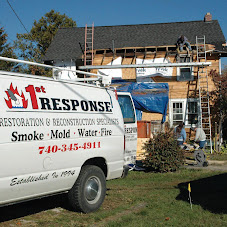
1st Response - A Full Service Construction Company


Someone recently asked me, "What all do you do out there, Craig?"

1st Response does THIS and MORE .........................

A Full Service Construction Company
Specializing in Fire, Smoke, Water & Storm Damage Restoration
Emergency Water Extraction
Dehumidification and Drying
Smoke and Odor Removal
Complete Structure Repair
Fire and Smoke Damage
Emergency Board-Up
Pack-outs and Storage
Debris Removal
Vandalism
Total Content Cleaning
Storm Damage
Electronics Cleaning

24 HOUR EMERGENCY SERVICE
740-345-4911

ADDITIONAL SERVICES PROVIDED

Drywall
Framing
Electrical
Plumbing
Finish Trim
Patio & Decks
Room Additions
Roofing & Siding
Carpet - Vinyl - Tile
Bathrooms & Kitchens
Door & Window Replacement

Puff Back ... the damage they can cause

Most people are not aware of puff back and the damage that it can do to their home or apartment. Home owners are more concerned about other dangers that can plague their home like water damage and other causes of house deterioration only.

For the sake of those people who are not aware of what a puff back is, I will give you two definitions. The most basic and simplest definition is that it is caused by an oil burner which has problems functioning properly. In highly technical terms, a puff back happens when a combustion chamber experiences an explosion caused by the speedy ignition of oil vapors and built-up gas inside.

Once this happens, and if you are in our FIVE country area, Licking, Knox, Fairfield, Muskingum, Perry or Coshocton, the quickest solution is to call us at 740-345-1911.This step should be done in order to eliminate the chances of a puff back from occurring again, and, to take the steps necessary to make the necessary repairs on your home.

Ironically enough, most people think that puff back is made entirely of dust. Contrary to its name, it is actually a part-petroleum based particle or oil-based particle that puffs back. This is even more dangerous than dust and trickier to dispel because the oil component that causes soot will stick to your house, clothes and furniture.

1st Response can also be called if you ever experience a puff back. Usually, we employ the same treatment that we use in fire and smoke restoration. Cleaning should be done within 48 hours of the occurrence of puff backs, in order to prevent more damage.

1st Response - 740-345-1911

Followers