Showing posts with label fairfield county. Show all posts

Thursday, June 14, 2012

MOLD


The best way yet to detect mold is simlpy to see and smell it.

Look for areas in the home that mold may be present.

Mold's favorite places happen to be bathrooms, kitchens, and basements.

Check any area that may have a lot of moisture.

Remember mold can be any color.

Red ,black, green, purple, or any other color.

If you can see or smell mold, then you have mold.

It is pretty simple.

Friday, March 16, 2012


While everyone else is gone for the weekend...we are here for you 24/7. 

If disaster should strike you, your friends, your family....CALL 1st RESPONSE! 


(740) 345-4911

and we will take it from there.

Friday, July 22, 2011

Some HOT Weather Suggestions

Fans and Ceiling Fans


If you’re looking for ways to beat the heat, a ceiling fan can be a great investment for your home. This one appliance can make a room feel 6 or 7 degrees cooler, and even the most power-hungry fan costs less than $10 a month to use if you keep it on for 12 hours a day. Good fans make it possible for you to raise your thermostat setting and save on air-conditioning costs. Fans don’t use much energy, but when air is circulating, it feels much cooler. Ceiling fans are best, but a good portable fan can be very effective as well.

You should remember that even mild air movement of 1 mph can make you feel three or four degrees cooler. Also make sure your ceiling fan is turned for summer – you should feel the air blown downward.

Shades, drapes, or blinds

Install white window shades, drapes, or blinds to reflect heat away from the house. Close blinds, shades and draperies facing the sun (east-facing windows in the morning and west-facing windows in the afternoon) to keep the sun’s heat out and help fans or air conditioners cool more efficiently. Always remember that the best way to keep your home cool is to keep the heat out.

Internal Heat

The most common sources of internal heat gain are; appliances, electronic devices, and lighting. Be aware from where the heat is comming. Now if you have air conditioning, use it wisely. Don’t put lamps, televisions or other heat-generating appliances next to your air-conditioning thermostat, because the heat from these appliances will cause the air conditioner to run longer. The heat they produce will make it think your house is warmer than it really is, and your system will run harder than it needs to.

•Unless you absolutely need them, turn off incandescent lights and heat-generating appliances. Replace incandescent bulbs with compact fluorescents; they produce the same light but use a fifth the energy and heat.

•You should also try to avoid heat-generating activities, such as cooking, on hot days or during the hottest part of the day. If you are cooking, use your range fan to vent the hot air out of your house. By reducing the amount of heat in your home, you will have to use less energy to cool it.

Other things to remember

Humidity makes room air feel warmer, so reduce indoor humidity. Minimize mid-day washing and drying clothes, showering, and cooking. And when you must do these things, turn on ventilating fans to help extract warm, moist air.

Avoid landscaping with lots of unshaded rock, cement, or asphalt on the south or west sides because it increases the temperature around the house and radiates heat to the house after the sun has set.

If the attic isn’t already insulated or is under-insulated, insulate it NOW. Upgrading from 3 inches to 12 inches can cut cooling costs by 10 percent.

Thursday, July 14, 2011

Some Summer Tips

Some "tips" to keep cool during these HOT Summer days.

1. Reduce the cooling load by employing cost-effective conservation measures. Provide effective shade for east and west windows. When possible, delay heat-generating activities such as dish washing until evening on hot days.

2. Over most of the cooling season, keep the house closed tight during the day. Don’t let in unwanted heat and humidity. Ventilate at night either naturally or with fans.

3. You can help get rid of unwanted heat through ventilation if the temperature of the incoming air is 77 F or lower. (This strategy works most effectively at night and on cooler days.) Window fans for ventilation are a good option if used properly. They should be located on the downwind side of the house facing out. A window should be open in each room. Interior doors must remain open to allow air flow.

4. Use ceiling fans to increase comfort levels at higher thermostat settings. The standard human comfort range for light clothing in the summer is between 72 F and 78 F. To extend the comfort range to 82 F, you need a breeze of about 2.5 ft/sec or 1.7 mph. A sow-turning ceiling-mounted paddle fan can easily provide this air flow.

5. In hot climates, plant shade trees around the house. Don’t plant trees on the South if you want to benefit from passive solar heating in the winter.

6. If you have an older central air conditioner, consider replacing the outdoor compressor with a modern, high-efficiency unit. Make sure that it is properly matched to the indoor unit.

7. If buying a new air conditioner, be sure that it is properly sized. Get assistance from an energy auditor or air conditioning contractor.

8. Buy a high-efficiency air conditioner: for room air conditioners, the energy efficiency ratio (EER) rating should be above 10; for central air conditioners, look for a seasonal energy efficiency ratio (SEER) rating above 12.

9. In hot, humid climates, make sure that the air conditioner you buy will adequately get rid of high humidity. Models with variable or multi-speed blowers are generally best. Try to keep moisture sources out of the house.

10. Try not to use a dehumidifier at the same time your air conditioner is operating. The dehumidifier will increase the cooling load and force the air conditioner to work harder.

11. Seal all air conditioner ducts, and insulate ducts that run through unheated basements, crawl spaces, and attics.

12. Keep the thermostat set at 78 degrees F or higher if using ceiling fans. Don’t air-condition unused rooms.

13. Maintain your air conditioners properly to maximize efficiency.

Monday, December 6, 2010

Some Winter Tips

Keep your headlights clear with car wax! Just wipe ordinary car wax on your headlights. It contains special water repellents that will prevent that messy mixture from accumulating on your lights - lasts 6 weeks.


Squeak-proof your wipers with rubbing alcohol! Wipe the wipers with a cloth saturated with rubbing alcohol or ammonia. This one trick can make badly streaking & squeaking wipers change to near perfect silence & clarity.

Ice-proof your windows with vinegar! Frost on it's way? Just fill a spray bottle with three parts vinegar to one part water & spritz it on all your windows at night. In the morning, they'll be clear of icy mess. Vinegar contains acetic acid, which raises the melting point of water---preventing water from freezing!

Prevent car doors from freezing shut with cooking spray! Spritz cooking oil on the rubber seals around car doors & rub it in with a paper towel. The cooking spray prevents water from melting into the rubber

Fog-proof your windshield with shaving cream! Spray some shaving cream on the inside of your windshield & wipe if off with paper towels. Shaving cream has many of the same ingredients found in commercial defoggers.

De-ice your lock in seconds with hand sanitizer! Just put some hand sanitizer gel on the key & the lock & the problems solved!
 
1st Response

Friday, November 19, 2010

More Winterizing Tips

WINDOWS AND DOORS:


Check windows and doors to prevent air from seeping into your home.

Checking for air gaps is done best on a windy day because you will be able to feel where the drafts are more easily. Light a few incense sticks and run them around door and window openings, watch the smoke trail and if there is a leak it will be real easy to spot.

A small 1/4" gap at the threshold of a door is equal to a 4" hole in the wall!

The rubber insert on thresholds tends to get hard and brittle with age and they tend to collapse so it may be time to replace it.. Most thresholds can simply be removed and a new rubber insert threaded in.

Don't overlook your wall outlets, its amazing how much outside air comes in around the openings.

Quick Fix: Install foam precut pads in behind the plates. Most all home building centers and hardware stores carry them.

Use a good quality caulking compound and seal up any cracks between the side walls of the house and the window frames. Clean and lubricate the window frame channels, if there are any gaps you can seal with one of the many strip adhesive backed weatherstrip available at local home centers and hardware stores.

Clean gutters & downspouts.Check the gutter supports.

Exterior paint-check for peeling, holes, cracks,soft and rotten wood, chalking.

Check siding-hammer in nails that have popped, replace rusty nails with galvanized nails.

Caulk any leaks or cracks in basement walls and seal.

See that all doors and windows close & lock properly. Lubricate hinges and door locks.

Thursday, October 21, 2010

Winter will be here soon

Winter may be a few months away, but now is a great time to start getting ready for it. With energy prices on the rise, it is important to find ways to cut costs and reduce the amount of energy you use in the winter. Let’s go over a few quick ways to help lower your energy costs and get ready for winter.


First, one of the easiest ways to dramatically reduce your home heating costs is by sealing your windows. There are many different kinds of window kits available that will completely seal off any gaps or drafts. Summertime is a great time to purchase these kits since they will typically be marked down by 50% or more. This means instead of spending $5 or more per window, you can do it for about $2.50 a window. If you’ve got a lot of windows in your home, this can really add up.

Summer is also a good time to start thinking about your insulation and the shape it may be in. If your home is fairly new, you should not have to worry about this. However, if you have noticed that no matter what you do your house still feels pretty cold, poor insulation may be the culprit. Look at the R rating on your current insulation and double check to make sure that it is meant for your area. If it is, it may have degraded, or you may need a little more to make your house feel cozy.

If you have a forced air heating system, it’s time to get those filters out and replaced. Having a clean filter in your furnace can reduce your heating costs significantly. Once again, you can take advantage of summer discounts and stock up on filters for the entire year. You should be replacing them at least every month, or more if you live in a particularly dusty area.

Wednesday, August 11, 2010

Some Hot Weather Tips

Some tips to help you keep your home a  little cooler during these very hot summer days.

Reduce the cooling load by employing cost-effective conservation measures. Provide effective shade for east and west windows. When possible, delay heat-generating activities such as dishwashing until evening on hot days.


Over most of the cooling season, keep the house closed tight during the day. Don’t let in unwanted heat and humidity. Ventilate at night either naturally or with fans.

You can help get rid of unwanted heat through ventilation if the temperature of the incoming air is 77 F or lower. (This strategy works most effectively at night and on cooler days.) Window fans for ventilation are a good option if used properly. They should be located on the downwind side of the house facing out. A window should be open in each room. Interior doors must remain open to allow air flow.

Use ceiling fans to increase comfort levels at higher thermostat settings. The standard human comfort range for light clothing in the summer is between 72 F and 78 F. To extend the comfort range to 82 F, you need a breeze of about 2.5 ft/sec or 1.7 mph. A slow-turning ceiling-mounted paddle fan can easily provide this air flow.

Try not to use a dehumidifier at the same time your air conditioner is operating. The dehumidifier will increase the cooling load and force the air conditioner to work harder.

Seal all air conditioner ducts, and insulate ducts that run through unheated basements, crawl spaces, and attics.

Keep the thermostat set at 78 degrees F or higher if using ceiling fans. Don’t air-condition unused rooms.

Maintain your air conditioners properly to maximize efficiency.

When an emergency arises, call 1st Response.

Wednesday, July 7, 2010

Some tips for summer living

Light and Airy - Make your home as light as possible. Invest in some thin and sheer curtains that look beautiful, provide privacy and keep the room cool. Heavy, synthetic drapes are definitely a no-no in the summer months. Beautiful cotton drapes in bold patterns and bright colors look good.

Cool Colors - Furnish your home in cool and soothing colors. Use bed sheets and pillow cases in colors like white, crème, yellow, blue, orange etc. Bed spreads and table cloths in vibrant patterns and flowery prints create a airy and relaxed atmosphere in the summer months.

Simplicity - Put away all your heavy and thick carpets that look and feel hot. Instead, invest in small and thin rugs that look good and feel great. Remember - less is more in summers!

Bring Nature to your Home - Seasonal flowers can brighten up your home. Pick flowers from your garden or invest in some fresh flowers for all the rooms of your home. Small, green plants create a cooling effect in your home.

In the afternoons, draw all the curtains of your house. This will automatically cool off the home and keep the heat out.

If you don't already have them, go shopping for some cheery wind chimes. Hang them at the entrance or high up where there is a cross ventilation. Let your home come to life with the soothing sounds of the chimes.

I you should suffer fire damage, smoke damage, water damage or storm damage, remember 1st Response.

Friday, June 18, 2010

Going Away??

If you are going on a week-end trip, business related trip, or a well deserved vacation you don't only need a "things-to-remember" list, but also a "Home To-Do List" as well. You do not want to find yourself in the middle of a business meeting, on the nice sunny beach or even just a 100 or so miles away when you get that panic feeling of "did I forget... did I remember... to do this, to do that?", pay that due bill, leave fresh water and food for the cat, etc.


So, when leaving, make these 4 tasks complete before you go, and also check out our time saving ideas as well.

It is highly suggested that you utilize automatic light timers that work just as well on radios, televisions, to make the home looked lived-in, like you are not away. Stop newspaper delivery for the time you are away, these piled up on your doorstep or end of driveway can be a real sign that your home is empty and no one is there, leaving you wide open and vulnerable. Mail too can be held at your local post office and resume delivery when you return home.

You can also use auto pay for your important bills. Pay utilities online so that the payment will be made via internet through your account, so you can rest assured that you do not miss a payment and a bill is not awaiting your return. You can even call your payments in using your Master or Visa card, and it is a secure way too. By taking the one-time payment option you can assure you will only be charged this one time while you are away enjoying yourself.

Not only do you have to make arrangement for your pets, but your plants as well. You can hire someone to water them or put them near your automatic sprinkler system if you have one. If you must leave your pets at home, make sure you ask a neighbor who is reliable and can feed and give them water daily. I also suggest they have their own vehicle to transport the pets in case of an emergency.

To save on some of the energy billing and reducing costs, turn off gas and water, unplug some of the appliances like the microwaves, televisions and other ones that you will not be utilizing. This also reduced the danger of power surges if you should experience a power outage while you are away. If you have gas stoves, turn off the pilot lights to save even more while you are gone.

There tips, as little as just paying a bill ahead of time, or using auto bill pay to putting lights on automatic timers can save you much stress and anxiety while being away from your home and assuring that your home and pets will be safe upon your return.

Saturday, May 22, 2010

Water Damage: How to protect your home

The first signs of water damage might seem trivial. But warnings like water stains on the ceilings or a leak under the kitchen sink can lead to real problems, like a weakened roof or rotten floorboards. A burst pipe can even damage your furniture and other personal possessions. Why take a chance? Learn where your home is most likely to suffer water damage, and what you can do to help prevent it.

Inside your home


Kitchen

•Dishwasher – Periodically check for leaks under the sink where the hose connects to the water supply. Look around the base of the dishwasher for evidence of leaks, such as discolored, warped, or soft flooring materials, or water damage to nearby cabinets.

•Refrigerator – If your refrigerator has an icemaker, make sure the hose connection is securely attached to the water supply line. Also, a wet spot on the floor may be a sign of a crimped icemaker line about to burst.

•Sink – Replace deteriorated caulk around sinks, and check the pipes under the sink for leaks. A slow-draining pipe may indicate a partially blocked drain that needs cleaning.

Bathroom

•Showers and bathtubs – Remove and replace deteriorated or cracked caulk and grout. Water can leak through these damaged sealants, causing stains or soft areas around nearby walls and floors.

•Sinks – Check under the sink for leaks from water supply lines or drainpipes.

•Toilets – Clogs can result from too much toilet paper or objects such as hanging bowl deodorants. Also, some chlorine tablet cleaners may corrode internal plastic or rubber parts, leading to a leak.

Basement, Laundry or Utility room

•Washing machine – Check hoses regularly for bulging, cracking, fraying, and leaks around hose ends. Replace the hose if a problem is found or every three to five years as part of a proactive maintenance program. To help make sure the hose doesn’t kink, leave at least four inches (or 11 centimeters) between the water connection and the back of the washing machine.

•Water heater – Most water heaters last eight to 15 years. Wet spots on the floor or a rusted tank may signal a leak. Water heaters should be installed on the lowest level of the home, next to a floor drain, or inside a drain pan piped to the floor drain.

•Sump pump – Battery-operated back-up sump pumps can help protect against power failure or failure of the primary pump. Test the sump pump before the start of each wet season. Sump pumps are not intended to last more than 10 years and must have some components replaced or serviced within those 10 years.

Since water may still come through an overflowing drain or cracks in the foundation walls, make sure items stored in the basement are kept off the floor. Furniture should be on casters or shims and arranged away from floor drains.

Stopping leaks at the source

•Check for hidden leaks. First, turn off faucets and all water-using appliances, and don’t flush toilets for one hour. Then, record the water meter reading. If the flow indicator (triangular or diamond-shaped rotating button) is spinning or the meter reading has changed while no water is being used, a leaking pipe may exist.

•Make sure everyone in your household knows where the water shutoff valve is and how to open and close it. Check it frequently for problems, and shut off the water if you will be away from your home for several days or longer.

Thursday, December 17, 2009


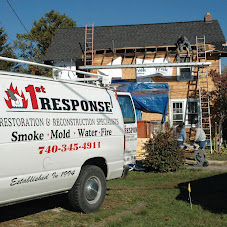
1st Response covers six counties in Central Ohio. They are Knox, Coshocton, Licking, Muskingum, Fairfield and Perry.

WE ARE A FULL SERVICE CONSTRUCTION COMPANY

Fire and Smoke Damage


Smoke and Odor Removal
Cigarette Smoke
Smoke from Fires
Skunk Odor
Structure Repair
Temporary Board-up
Structure Cleaning
Drywall Repair
Painting
Cleaning and Restoration
Office Furniture
Carpet
Upholstery
Drapery
Total Content Cleaning

Water Damage

Water Extraction
Drying Dehumidification
Interior Wall Drying
Mold and Mildew Odor Removal
And Containment

Carpet Restoration
Cleaning and Deodorization
Carpet Pad Removal and
Replacement
Carpet Replacement

Repair and Reconstruction
Base Removal and Replacement
Drywall Repair and Replacement
Stain Removal
Specialty

Electronic Equipment Restoration
Stain Removal
Fine Arts Restoration
Document Restoration

Followers